Fishing the Mid Atlantic region and beyond for all manner of salt and fresh water species. We cover the lower Chesapeake Bay aboard the "Mikey D Fishing" in search of stripers, redfish, speckled trout, flounder, cobia and chase trout across the classic freestone and limestone streams of Pennsylvania, Maryland, West Virginia, and Virginia.
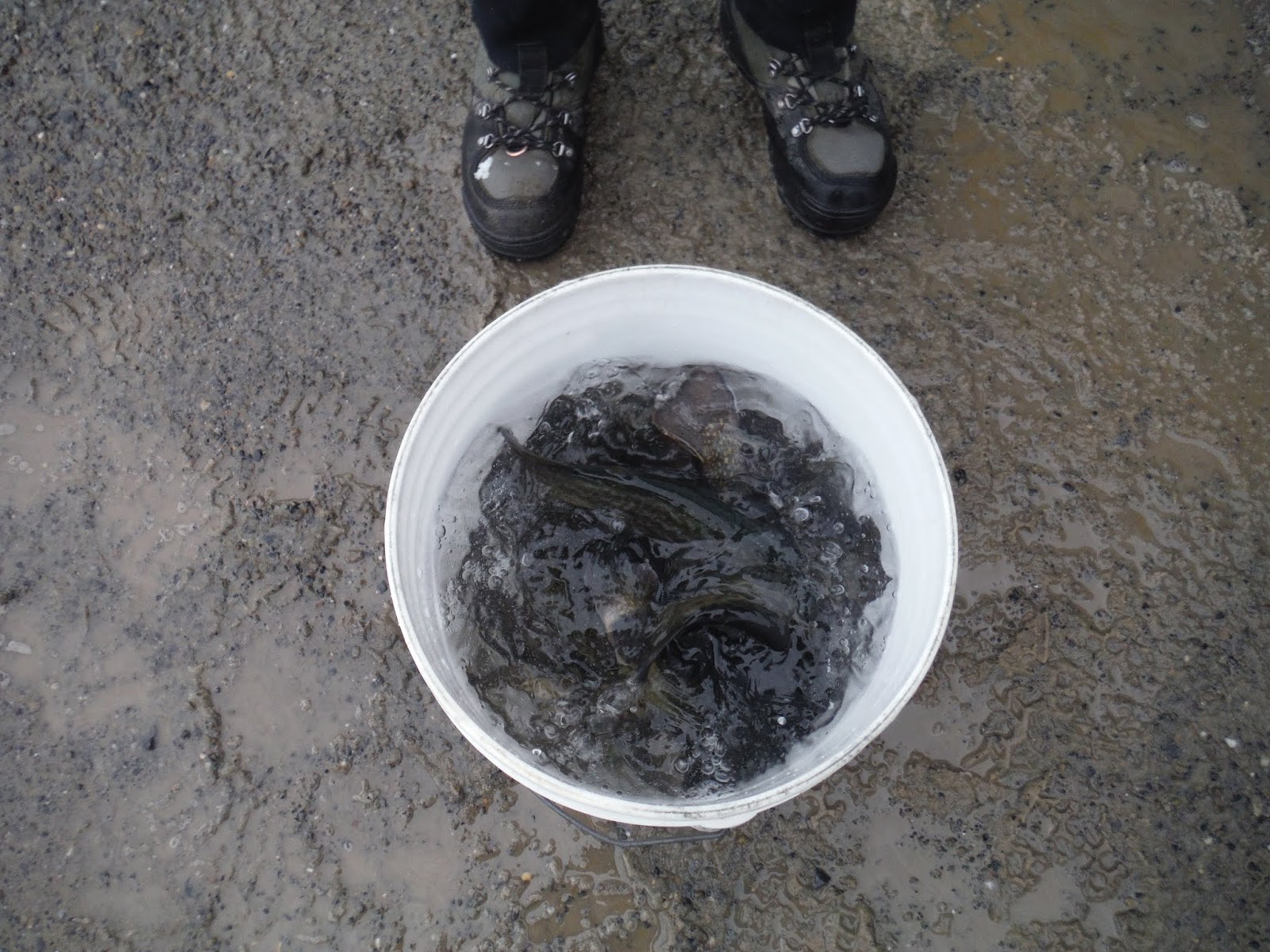
What better way to recover from our amazing fishing trip in Louisiana than hauling buckets of trout to the stream so the "bait chuckers" can pull them out in a week. To be fair, stocking is actually kind of fun, but it's also a workout.
Two weeks ago I helped members of the Roulette Rod and Gun Club stock both branches and the main stem of Fishing Creek. Today it was the state's turn to provide the fish. Weather conditions were not quite as nice as Louisiana. As I headed to the rendezvous point with the truck and WCO, there was about a half inch of snow on the ground, and temps in the mid 30s.
Joining me in the outing was neighbor and fellow TU chapter member Bob "The Trout Whisperer" Volkmar. We and about 7 other vehicles met up at the ABC Motel on Rte 6 at 1015, then headed to various destinations on Fishing Creek.
Not a lot of technique involved here. The driver nets the fish and puts them into buckets, the WCO hands the buckets down to us schlubs, and then we amble off to dump the fish into the stream.
We tossed our last bucket o trout around 1:15 in the afternoon. I think we stocked around 2,000 fish two weeks ago, and added another 1,000 or so today. The big difference between the two stockings was fish size. Most of the fish stocked with the club ran in the 12 inch range. Today we put in a good number of 16-18 inch Brookies, Browns, and Rainbows.
I'm sure that's the reason why many of the folks in the "conga line" of vehicles didn't get out of their cars. They really weren't there to haul buckets. As I said, there are stockers, and then there are stalkers. And then there are slackers....
Author and playwright Mehmet Murat ildan wrote,
“When there is nothing left to learn from the winter, move on to the spring!”Unfortunately, my winter learning curve
peaked in January, and it’s been a long crawl since then to get to spring-like
conditions.Even then, spring in Potter
County is a fickle thing.A few days of
warm temps are easily followed by the return of cold and snow.
Fortunately, Captain DiPaola had the remedy at
hand.I’m sure everyone who reads this
blog has seen fishing shows which center on southern Louisiana.So, when Joe suggested we check out the
fishery in person, there was no hesitation, and we headed off to Venice, Louisiana.
Getting to Venice was fairly
uncomplicated.Southwest flies direct to
New Orleans.From there you simply hop
into a rental car, get on I-10 East, and about 10 miles out of NOLA take
Louisiana Highway 23 south.From there
you simply drive straight another 50 miles or so until you run out of dry real
estate, and you’re in Venice.
Along the way you get an appreciation of the principal
threat to the folks who live in Plaquemine Parish.Not long after getting on the highway you look
to your left and see the twenty-foot high levee holding back the Mississippi.A little south of Belle Chase and you see an
additional twenty-foot high levee that holds
back the Gulf of Mexico.Folks who have
the money put their houses (and the schools, for that matter), on high
stilts.Unfortunately, those with lesser
means are at nature’s mercy.So, while
we know the images of New Orleans during Hurricane Katrina, you can only
imagine what the 27-30 foot tidal surge did in the lowlands to the south.
We arrived at the Venice Marina, where we had
rented a houseboat (actually, a house on a barge … very comfortable) for the
next two days, just as the offshore and inshore charter captains were pulling
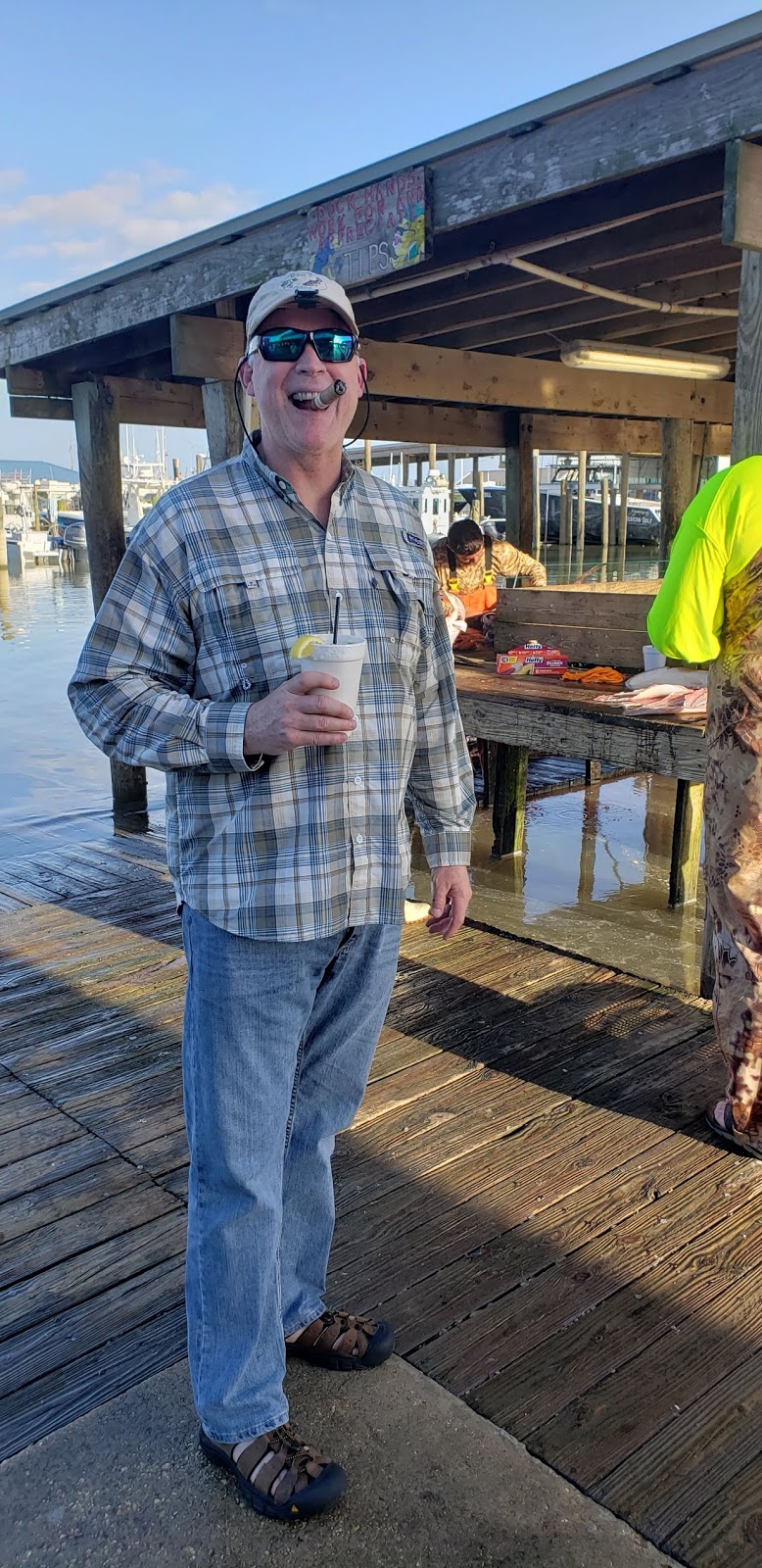
in. Venice advertises itself as the fishing capital of the world.Watching the fish being offloaded, you’d have
a hard time arguing against the claim.Swordfish, Tuna, Red Snapper, and Redfish in large numbers all made
their way to the cleaning stations.Hanging
out with a drink and a cigar under sunny skies and temps in the low 80s only increased
our eagerness to hit the water and experience the fishing ourselves.
That would have to wait until Sunday.Saturday evening, we met up with our guide, Captain
Herman Demoll, owner of Cajun Culture Fishing Adventures (www.cajunculture.net), at “Changes,” a
local restaurant owned by Herman’s aunt and uncle. Over gumbo and boiled crawfish,
we got to know Captain Herman, his history, and the culture of the area. As I mentioned earlier, the area is ground
zero for severe tropical weather.And job
opportunities are also pretty limited.You’re either working the oil and gas rigs, or working the water.It’s amazing that folks choose to endure such
tough conditions.But they do, which is
as good a definition of resilient as I can think of.
Fortunately, Captain Herman is one of those
folks.As I’ve mentioned in previous
posts, although we’ve had a few clunkers for guides, overall, we’ve had more
success than failure.Captain Herman did
not disappoint.A fifth-generation
fisherman, Herman proved to be the consummate guide and angler, and a living
reflection of Cajun history, culture, and hospitality.
For the next two days we experienced firsthand
the amazing inshore fishery in the Mississippi delta.Captain Herman would pull up to the houseboat
promptly at 0615, load our gear, and head off.Both days we fished during an outgoing tide at an area known as the “Wagon
Wheel.”As the name suggests, it’s a circular-looking
area just west of the marina.From a map
it looks only a distance of a few miles to the west.But there are no straight lines to get to the
great fishing spots.The boat ride alone
was worth the trip.Captain Herman
demonstrated the worth of five generations of knowledge as he navigated the marshes. I’m not a great judge of speed, but we were
moving at a good clip, and in some cases in channels that were not much wider
than his skiff.
Within an hour or so he had us set up in what
would be one of two fantastic fishing spots for the trip.The first was essentially a 5-6 acre cul-de-sac
of water surrounded by cane and other grasses.His fishing technique was straightforward.We first anchored at the mouth of the hole,
rigged up spinning rods with popping corks, about 12 inches of leader, a small
weight, and a Kahle hook, kind of an offset circle hook.Since crawfish season had recently opened, live
mudbugs were the bait of choice.Baiting
the hook was simple enough; just push the hook through the tail of the crawdad,
and cast it close to the bank.From
there the technique got a little more complicated.The popping cork is designed to make a
snapping noise when the rod tip is jerked, a noise which is like a dinner bell
to a Redfish.Key to the technique,
though, is slack and patience.Keeping
slack in the line gives the fish time to take the bait and run.Patience improves the chances of a successful
hook up.So, when the cork went under, a
five second pause, followed by reeling in the remaining slack and setting the
hook, usually meant fish on!The technique
took a bit of time to master, with a good number of early misses.But once we figured it out, fishing turned to
catching.And when the bite slackened,
Captain Herman would simply move the boat to another section of the hole, drop
the power poles, and we’d go back to catching.
The action was virtually non stop for about three
hours, and we boated over twenty fish, almost all bigger than the 16-inch slot
limit, and two in the 27-plus inch range that qualifies a Redfish as a “bull.” I even had a brief encounter with a Red on the
flyrod.Unfortunately, the great weather
that greeted us on Saturday failed us on Sunday.A front moved in the late morning, with gusty
winds, cooler temps, and heavier rain than forecast.We had rain gear, but it wasn’t up to the
conditions.So, after hitting a few more
spots with only a few hookups, we opted to get back to the warmth of the
houseboat a bit early.We could have
toughed it out.But the fishing had been
so great, with an improved forecast for Monday, that we could easily call the
day a success.
We hopped onboard Captain Herman’s boat the
next day with clear skies, temps in the low 50s, a bit breezy but seemingly not
enough to keep us from our mission of catching a Red on a fly.We began at the same hole that we had hit on
day one.But unlike the previous day,
while we caught good numbers of fish, we caught much bigger fish, several in
the bull-class.Having circumnavigated the hole, Captain Herman pulled up the power poles to hit a second hole, which
turned out to be the hottest spot of the trip.Again, he zigged and zagged the skiff around and through the Wagon
Wheel, stopping at the entrance of a small creek channel connecting two larger
holes.The channel itself was nothing to
look at; about 60-80 feet long, 30 or so feet wide, 3-4 feet depth on the left
bank, and shallowing as you went towards the right bank.Beyond the channel you could discern a hole of
2-3 feet depth about 80 feet in diameter.But inside the channel and the hole on the other side were an incredible
number of Reds.For at least an hour and
a half we were tying into fish on almost every cast, and again many of them
were better than 27 inches.We doubled
up on more than a couple of occasions, which was somewhat dicey considering the
narrowness of the channel. But the urge to tie into another big Red threw
caution to the wind.
After a bit we decided to try the flyrods one
more time.Captain Herman moved up into
the channel a bit to get us closer to the far hole.From there it didn’t take long for each of us
to claim our first Redfish on a fly.Mission accomplished!
We hit one more spot that Captain Herman was
interested in, but didn’t see much action, so we decided to head back to the
marina.Anyway, the thirty-three fish
that we caught and released suggested a pretty good day.Bidding Captain Herman adieu, we drove back
to NOLA, where we experienced a bit of the French Quarter, had a great meal at
the Bourbon Street Grill, and finished the night with a couple of Sazeracs at
Galatoires.The perfect end to a perfect
fishing expedition.
Our thanks to Captain Herman of Cajun Culture
Fishing Adventures, who made the trip an incredible fishing experience!!!
Second big snow of the year hit yesterday afternoon. Light snow started coming down around 1200 or so. By the evening, the skies opened up and the snow started "bigly."
Mary and I got a good 2 hours of shoveling in Saturday night, fueled by Jefferson's and an Ashton.
We probably pushed about 6 inches of the white stuff, and high tailed it back to the cabin to watch the Penguinis lose to Vegas.
A good thing that we conducted a shovel-ex Saturday night, because over the next 7 hours another 12 inches of snow covered the driveway. So, back to the grind for another couple of hours.
While temps were in the low teens, the wind wasn't too bad, so we donned the snowshoes and took a look at the water:
So ... it looks like the fishing is going to be kind of slow for awhile. What to do while waiting for the weather to turn....
Fishing conditions up in God's Country have been less than ideal since the middle of November. But as 2018 was coming to a close, the weather gods took some pity on us and offered a couple of days of decent (which in the high lonesome means temps in the mid to upper 30s) weather, at least conditions where your rod guides don't freeze up.
An impending trip to Chicago prevented me from attending Capt. Dipaola's bacchanalian New Years Eve party in Bethany Beach. Instead, on the last day of 2018, Bob (aka "The Trout Whisperer") and I lit out for a few hours on Oswayo Creek, a Class A wild trout stream about 20 minutes from the West branch Tavern. Despite all the recent rain, water conditions were excellent; good flows, temps in the low 40s, about as good as it's going to get for late-December.
We worked the stream for a good three hours, alternating between fishy-looking spots, mostly undercut banks, spots where you'd think a wild Brown would be hanging out. We swung a variety of streamers, which you'd think would have brought some fish to the net. Unfortunately, while we covered a good deal of the stream, we failed to move a single trout.
By the afternoon the forecast rain started, but we were geared up and decided to try another stream. About two miles upstream from where we fished is the Oswayo fish hatchery. Behind the hatchery Oswayo Creek takes on the look of a mountain Brookie stream; small water with pockets and undercut banks.
It was easy getting around this water, the Hemlock canopy kept the underbrush to a minimum. Casting still proved to be challenging due to tight conditions. But small stream fishing can be really rewarding and equally frustrating. I came upon a little pool about half the size of a bathtub. Unfortunately, fallen trees obscured most of the hole; a perfect place for a trout lie, but also a tough place to properly place a fly. Nevertheless, I managed to flip a black (Mary tied) Woolly Bugger, to the top of the pool, only to freeze when I saw a big blob of orange come up and felt the slight tug on the rod. For me that was extent of my action. The Trout Whisperer, however, demonstrated his highly honed skills by landing a nice 7 inch native Brookie.
Not long after Bob's victory the rain started to get irritating, so with the skunk off we decided to end 2018 on a good note, but also looked to kicking off 2019 by hitting another stretch of water. On New Year's Day we drove down to fish the East Fork of the Sinnemahoning, a tributary of Sinnemahoning Creek, which itself is a 15 mile tributary to the West Branch Susquehannah. Several other streams, some of them Class A, also empty into the Sinnemahoning. Our decision to hit the East Fork was driven by a good dose of rain New Year's Eve. We figured that the larger streams would be blown out, but the upper tribs would be fishable. Again, our hunch proved right. The put-and -take section of the East Fork was in great shape.
The East Fork is your typical PA freestone stream, offering riffles, runs, nice pools, undercut banks, and again a Hemlock canopy that made for easy access. We only fished for a couple of hours, and hit some really trouty-looking spots, but aside from one bump on a black Woolly Bugger swung under an overhanging tree, we were not rewarded for our efforts.
Two days of fishing and only one fish might not seem like a good return on the investment of time. But given that we were able to get out at all made the time worthwhile. Conditions this weekend are forecast to be in the upper thirties and dry. While I'm stuck in Chicago, my hunch is that Bob will be heading back to the bathtub pool on the Upper Oswayo to flip a Bugger to the orange blob. Not a bad way to kick off 2019.
Bare trees and cold temperatures are a harbinger for the end of the Chesapeake fishing. On this Thanksgiving day, it is fitting to take stock and look back at the angling triumphs and tribulations. On November 16, while Capt Felker was advising the Madagascar Military Academy, I decided to pull and clean the boat in preparation for shrink wrap and winterization.
The ride from home port to the ramp at Sandy Point was a cold one. Winds were 10 -15 out of the Northwest, the air temperature was 42, and water temps were in the upper 40s. Scanning the horizon from north to south revealed only a few sailboats. Unlike autumn fishing in recent years, bait was not to be found in the middle bay, absent were schools of keeper rockfish and gulls that typically mark fish from above were nowhere in sight. October through mid November are typically the most exciting and productive time for striper hunters. Schools of rockfish measured in acres blanket the bay. We incorporate a shoot and scoot tactic to move from one productive spot to the next. When the fish are holding in deeper waters, we will jig with BKDs and metal jigs to hook keepers.
This fall was different. Despite unsubstantiated Maryland Department of Natural Resources reports of excellent "Roctober" fishing, fellow regular anglers and charter captains agreed with Mikey D Fishing that the October / November striper season was a disappointment. Our theory is that the record rainfall and subsequent opening of the Conowingo Dam decreased the salinity of the upper and middle bay region. Bait moved south early, taking most stripers of note with them.
The good news is that the fall fishing did not dampen what was a memorable season overall. The saltwater season commenced in spectacular fashion with Capt Felker and Capt DiPaola catching Nicaraguan tarpon on the fly! Late May and early June produced large number of keeper rockfish including a banner weekend in mid June when we brought multiple keepers including two 30" plus fish over the gunwale. When fish were constrained into a small area near Rock Hall by poor oxygen levels in July, Mikey D Fishing was there with simultaneous hook-ups. During that trip we witnessed the appalling amount of trash and debris moving downstream from the Susquehanna river. A late summer tow that took us miles from the fishing grounds ultimately rewarded us with keeper rockfish. We caught fish jigging, with fly rods, on bait-runner reels, and in almost every available manner. We landed our largest Cobia on our trek to the Southern Bay. At the northern outpost in Potter County, Capt Felker continued to expand local knowledge of streams and creeks in north central PA. Summer is never more in bloom than when you feel the tug of the line and bring a trout to hand on a clear day. We enjoyed the company of regular fishing friends and guests. It was a great season and we have much for which to be grateful.
2019 fishing is only a few short months and a thaw away. We are looking forward to the inaugural Charter season and Capt Felker's Montana fly fishing guide school matriculation. Fish on the line or half off so book now!